
Here’s an uncomfortable truth about job hunting right now: employers are on high alert. This week, 92% of UK graduate employers said they suspect or have confirmed cheating in hiring — mostly undeclared AI use (Institute of Student Employers, via The Guardian, October 14, 2026). And 1 in 4 people who let AI write their resume lost a job over something the AI made up (Novoresume, 2026).
So if you want to tailor resume to job description with AI — honestly the fastest way — do it the honest way. 64% of employers now allow some AI use, up from 46% last year (same ISE survey). They don’t punish tailoring. They punish fakery.
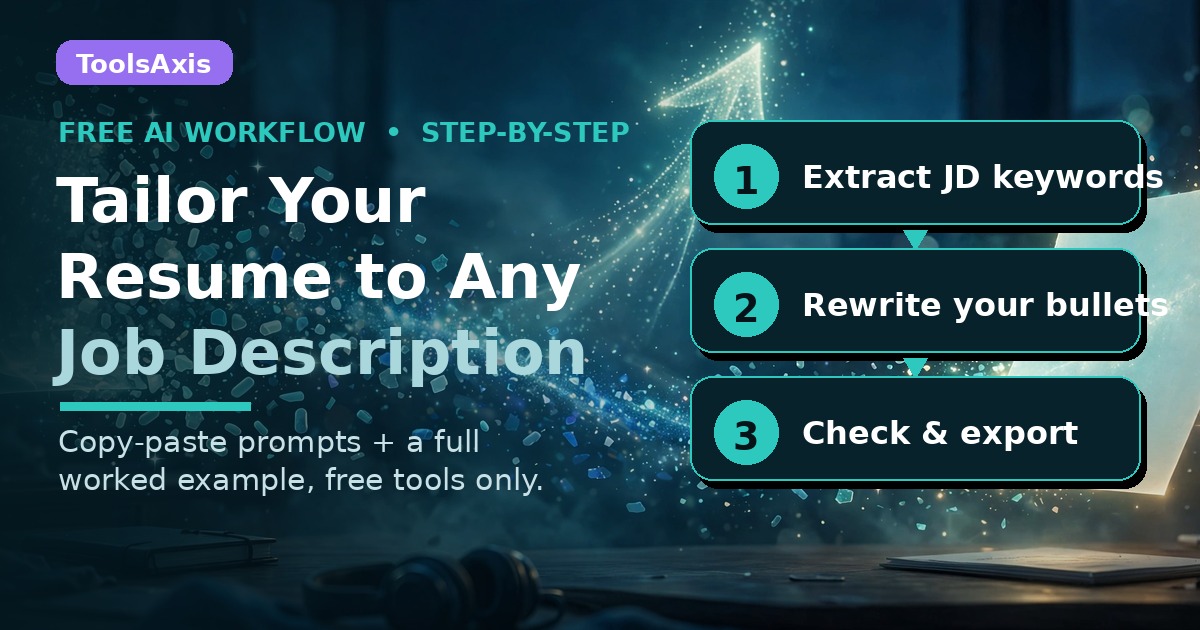
In this guide you’ll find: the 5-step workflow — extract the posting’s keywords, find your honest gaps, rewrite bullets without inventing experience, run a skeptical honesty audit, check your match. Plus 8 copy-paste prompts, a worked example with real before/after scores, a free-tool comparison table, and where tailoring ends and cheating begins.
TL;DR: Paste the job description into a free AI tool and extract the 20 keywords an ATS scans for. Mark your honest gaps against your resume. Rewrite bullets around keywords you genuinely have — never invent skills or numbers. Make the AI audit your draft like a skeptical hiring manager. Check coverage, export as PDF, apply. ~20 minutes once you’ve done it twice.

Why tailoring matters more than ever in 2026
UK graduate employers got 141 applications per vacancy this year — 172 in London (ISE, October 2026). When a human or an ATS spends seconds per resume, the ones mirroring the job description’s language survive. Meanwhile 66% of those employers have caught undeclared AI use during interviews — candidates sounding “like they’re reading off an Autocue.” And 84% of job seekers used AI during their search (Workday, October 2026).
So here’s the shift: don’t use AI to write your resume. Use AI to tailor it. Tailoring = expressing YOUR real experience in the employer’s language. Writing = letting the machine invent a candidate. Recruiters smell the second one instantly.
How we tested (so you can trust this)
I ran the full workflow on a fictional sample resume (Daniel Reyes, a customer support rep in Austin — a non-tech career pivot, since most guides assume you’re an engineer) and a typical Marketing Coordinator posting:
- ChatGPT guest mode (zero signup): four prompts — keyword extraction, gap analysis, bullet rewriting, honesty audit. Every output quoted is real.
- Gemini (temporary chat): same keyword prompt — near-identical list.
- ResuHive (no account): scored the untailored resume 40/100, “Needs improvement.”
- CareerDiary.io (guest flow): tailored it in ~30 seconds, scored 71/100.
- Teal, Jobscan, Rezi, Kickresume pricing pages: verified free-tier limits this week.
- Enhancv’s checker (new URL: enhancv.com/resources/resume-checker/): no signup, but upload-only (PDF/DOCX, 2MB max).
The 5-step workflow
Each step has a copy-paste prompt (full library at the end). Budget 20–30 minutes first time, ~15 after that.
Step 1: Extract the JD’s keywords (5 min) → Step 2: Find your honest gaps (5 min) → Step 3: Rewrite your bullets (10 min) → Step 4: Audit for honesty (3 min) → Step 5: Check coverage, export (2 min).
Step 1: Pull the real keywords out of the job description
Don’t guess what the ATS scans for — the posting tells you. Paste it into ChatGPT (free, no signup) with:
“Here is a job description: [PASTE JD]. Extract the 20 most important keywords an applicant tracking system would scan for. Group them: Must-have skills, Tools & platforms, Soft skills & traits. Plain lists, no fluff.”
For our Marketing Coordinator posting: must-haves — email marketing campaigns, social media content creation, campaign performance tracking, Google Analytics, SEO & keyword research, on-page optimization, event marketing; tools — HubSpot, Mailchimp, GA4, Buffer, Hootsuite, Canva; soft skills — written communication, cross-functional collaboration, multitasking, attention to detail. That’s the employer’s vocabulary — “email marketing campaigns,” not “emailing.”

Step 2: Find your honest gaps
Paste your resume plus the keyword list:
“Here is my resume: [PASTE RESUME]. Here are the JD keywords: [PASTE KEYWORDS]. Which keywords does my resume already cover — with the exact bullet proving each — and which are genuine gaps? Be strict: don’t claim I have a skill unless my resume shows real evidence.”
That last sentence is the most important in this guide. It turns the AI from fiction writer into strict auditor. For our sample it found exactly one clearly covered keyword (written communication) and one partial (cross-functional collaboration) — everything else, all 18, were genuine gaps. It added a wise caveat: a skill not mentioned isn’t necessarily a skill lacked; it’s a gap in evidence. Dig through your memory before declaring a gap.
For a real gap, you have three honest moves: learn it fast (HubSpot’s free Academy certifications take hours and go on your resume as a real line), bridge it (“tracked weekly metrics in spreadsheets” honestly maps to data analysis), or leave it out. 12 truthful keywords beat 20 fraudulent ones.
Step 3: Rewrite your bullets around keywords you actually have
“Rewrite these resume bullets to mirror this job description’s language: [PASTE BULLETS]. Keywords to weave in: [PASTE KEYWORDS]. Rules: never invent experience, numbers, tools, or results I didn’t have. Keep every claim defensible in an interview. One or two lines per bullet.”
Before:
- “Helped customers with their problems every day”
- “Worked with team members on various tasks”
- “Stocked shelves when needed”
After (the AI’s real first draft, verbatim):
- “Resolved daily customer issues by responding to customer needs and providing support.”
- “Collaborated with team members to coordinate tasks and support daily operations.”
- “Restocked shelves as needed to maintain product availability and store organization.”
Better — but notice the AI quietly upgraded “worked with team members” into “coordinate tasks” and invented “store organization.” Nobody asked it to. That’s why Step 4 exists. The audited, honest finals:
- “Assisted customers with questions and problems on a daily basis.”
- “Worked with team members on various tasks to support store activities.”
- “Restocked shelves as needed.”
Same person, same three years — now speaking marketing coordinator without one invented fact. The two-minute interview test: read each bullet and ask, “Could I talk about this for two minutes without making things up?” If no, cut it.
Step 4: Make the AI play skeptical hiring manager
The step everyone skips — and the one that keeps you out of the “1 in 4 lost a job” statistic:
“Review this like a skeptical hiring manager: [PASTE SECTION]. Flag anything exaggerated, invented, or unverifiable — quote the phrase, explain why it’d fail in an interview, suggest an honest replacement.”
It flagged five phrases in its own draft — “coordinate tasks” (potentially exaggerated), “store organization” (not explicitly supported), plus three milder stretches. Verdict: “No major fabrication detected, but the phrases above go beyond the exact evidence.” Use the AI against itself — the closest thing to a free recruiter pre-screen.
Step 5: Check your score and export
The payoff, measured: ResuHive scored our sample 40/100 (“Needs improvement”) before tailoring — 4 keywords covered. After tailoring: 60/100 (“Good match”). Twenty points from honest reframing alone.
The remaining misses — email marketing, Google Analytics, SEO, HubSpot — are genuine gaps, exactly what Step 2 found. A 60/100 built on truth survives the interview; a 95/100 built on fiction won’t survive the first question.
Export as PDF (never .docx — PDFs survive every ATS), then run a free ATS scan. Our 7 free ATS resume checkers compares the options — Enhancv’s does 27 checks with no signup, though it’s upload-only.
A note on screenshots: I ran every prompt above in the tools’ real free tiers and quote the actual outputs — but I couldn’t capture interface screenshots from my setup, so illustrations stand in. The words are real; the pictures are representative.
Every free tool, honestly compared
Free-tier facts verified on official sites and in hands-on tests, October 17–18, 2026 (prices change — treat as a snapshot):
| Tool | Free tier for tailoring | Signup? | The catch |
|---|---|---|---|
| ChatGPT (guest) | Full workflow: keywords, gaps, rewrites, audits — all four prompts, zero signup | No | Free-tier limits apply; no model name shown |
| Gemini | Keyword extraction + rewrites (near-identical 20-keyword list to ChatGPT’s) | Google account | Temporary chat available |
| ResuHive | JD line-by-line matching + score + ATS parse preview | No (“nothing you paste here is saved”) | 3 checks/day; rewrite needs sign-in; paid from $4.90/mo |
| CareerDiary.io | Full AI tailoring as guest (~30s, 71/100 with before/after views) | No (guest flow) | 5 AI credits/day; download likely needs account; Pro $9/mo |
| Teal (tealhq.com) | Top-5 JD keyword matching, unlimited resumes + tracking | Yes — signup wall before you can attach anything | 10 AI bullet credits, 2 summaries; Teal+ $13/wk or $29/mo |
| Jobscan | 5 free resume scans/month, ATS + recruiter findings | Free account | 5 scans go fast; paid $49.95/mo (or $29.98/mo quarterly) |
| Rezi | 1 resume, AI writer + editor, 3 PDF downloads | Free account | Very limited; Pro $29/mo |
| Kickresume | 4 templates, 20,000 pre-written phrases, unlimited downloads | Free account | Basic templates; Premium $8–24/mo |
| Enhancv checker | 27-point ATS scan | No signup demanded | Upload-only (PDF/DOCX, 2MB); old URL now 404s |
My honest take: start with ChatGPT guest mode — free, no signup, handled the whole workflow. Add ResuHive for a brutally honest number. Pay only at serious volume. Our AI resume keyword finder guide tested 7 free extractors — 4 needed zero signup.

Where tailoring ends and cheating begins
The tells that get you rejected: oddly formal language, filler where a real story should be, keyword-stuffed summaries, skills you can’t discuss. Two-thirds of UK employers have caught undeclared AI use in interviews (ISE 2026) — they’re actively looking.
What’s completely fine: extracting keywords, rephrasing real bullets, checking grammar. 64% of employers explicitly allow some AI use. It’s proofreading, not inventing.
The rule I use: remove the AI — would the resume still be true? If yes, you tailored. If it collapses without the AI’s inventions, you cheated. Stay on the right side and AI is your unfair advantage.

The copy-paste prompt library
All 8 prompts in one place. Replace the [BRACKETED] bits.
P0 — Understand the role: “Summarize this JD: [PASTE JD]. The 3 most important needs, what a great day one looks like, mandatory vs nice-to-have. Under 150 words.”
P1 — Extract ATS keywords: “Extract the 20 most important keywords an ATS would scan for in this JD: [PASTE JD]. Group: Must-have skills, Tools & platforms, Soft skills. Plain lists, no fluff.”
P2 — Honest gap analysis: “My resume: [PASTE RESUME]. JD keywords: [PASTE KEYWORDS]. Which keywords does my resume cover — with the exact bullet proving each — and which are genuine gaps? Be strict: don’t claim a skill without real evidence.”
P3 — Rewrite bullets: “Rewrite these bullets in this JD’s language: [PASTE BULLETS]. Keywords: [PASTE KEYWORDS]. Never invent experience, numbers, tools, or results. Keep every claim interview-defensible. 1–2 lines per bullet.”
P4 — Rewrite summary: “Rewrite my professional summary for this JD: [PASTE JD]. Current: [PASTE SUMMARY]. My real background: [PASTE 2-3 facts]. 3 lines max, no buzzwords, no unprovable claims.”
P5 — Rebuild skills: “Build a skills section from ONLY these verified skills: [PASTE SKILLS]. 2–3 short lines, grouped by type. Add nothing I didn’t list. Mirror the JD’s wording where my real skill matches.”
P6 — Skeptic audit: “Review this like a skeptical hiring manager: [PASTE SECTION]. Flag anything exaggerated, invented, or unverifiable — quote the phrase, explain why it’d fail in an interview, suggest an honest replacement.”
P7 — Coverage check: “My tailored resume: [PASTE RESUME]. JD keywords: [PASTE KEYWORDS]. What percentage appear naturally? List important ones still missing and where each could fit without stuffing.”
If you’re a student, fresher, or career changer
Most tailoring guides assume a mid-career pro. Let’s fix that.
Students / freshers: coursework, projects, volunteering, and part-time work are experience. Run P3 on project descriptions — “Led a 4-person team building a budgeting app” maps to “cross-functional collaboration.” Don’t inflate a two-week tutorial into “designed enterprise systems.” P6 is your best friend here.
Career changers: you’re Daniel from our example. Your superpower is transferable skills — P2 finds them. Don’t hide your old field; translate it. One honest summary line — “Customer support specialist bringing 3 years of high-volume communication experience to marketing” — beats any keyword trick.
Returning after a break: lead skills-first, keep chronology honest — name the break in one line, then let skills talk. A hybrid format (skills up top, condensed history below) usually serves returners best.
FAQ
Is it cheating to use AI to tailor my resume?
No — if every word stays true. 64% of employers allow some AI use (ISE 2026). Extracting keywords, rephrasing real experience, and checking grammar is tailoring. Inventing skills or achievements is cheating — and 1 in 4 people who submitted fully AI-written resumes lost a job over the inaccuracies (Novoresume 2026).
How long does tailoring take per application?
20–30 minutes the first time, ~15 once it’s muscle memory. Five precise applications beat fifty generic ones.
Should I use a different resume for every job?
A different tailored version, yes — keep one master resume, tailor a copy per application. Never rely on one generic resume with 141 applicants per role.
What if the job description is vague?
Use P0 to squeeze out what matters, tailor to the obvious keywords (title, industry, seniority). A vague JD usually means a human screens first — clean formatting matters more than keyword density. Start from our ATS-friendly resume templates.
What if I don’t have most of the keywords?
Apply honestly at ~60% match (that’s normal), and use your Step 2 gap list as an upskilling plan. Don’t fake the other 40%.

Your 20-minute tailoring checklist
- ☐ Paste the JD → extract 20 keywords (P1)
- ☐ Paste resume → honest gap analysis (P2)
- ☐ Rewrite 3 weakest bullets (P3) + summary (P4) + skills (P5)
- ☐ Skeptic audit (P6) — fix every flag
- ☐ Coverage check (P7) — fill honest gaps only
- ☐ Export as PDF, run a free ATS scan
- ☐ Read it aloud — if it doesn’t sound like you, fix it
Twenty minutes, zero dollars, and a resume that speaks the employer’s language without one untrue word. Our ATS-friendly resume templates give you a clean base to tailor from, and the free AI resume builders we tested can format it once your content is ready.
Add ToolsAxis as a Preferred Source in Google Search — open any of our articles in Google, tap the star/source icon, and choose ToolsAxis. You’ll see our newest job-seeker-tested AI guides first.
Get One Useful AI Tool Tip Every Week
One practical AI tool tip in your inbox every week. No spam, unsubscribe anytime.

We’re the team behind ToolsAxis. We hands-on test free AI tools for job seekers — signing up for free plans, taking real screenshots, and fact-checking every claim before publishing. Our guides cover resumes, ATS optimization, interview prep, and LinkedIn.
Enjoying ToolsAxis guides?
Add us as a Preferred Source on Google — you'll see our latest tools and guides first in Search, Top Stories, and AI Overviews.